
Lubricants? The way to quantum advantage!
Of all the technologies humanity has perfected, lubricants might be among the least glamorous. At first glance, they seem like the kind of product that has barely changed in a century. But there is more going on inside that bottle than meets the eye. A drum of synthetic oil can contain a molecular puzzle: a mixture of similar hydrocarbon molecules with different structures.
One widely used class of synthetic lubricant base oils is polyalphaolefins, or PAOs. They are made by joining small hydrocarbon building blocks called alpha-olefins—often 1-decene—into larger molecules. The result is not necessarily one molecule but a population of oligomers, such as dimers, trimers and tetramers, along with their isomers: molecules with the same molecular formula but different structures. The mixture varies with the feedstock and production process [1].
Molecular size and branching influence how an oil behaves, including its viscosity, viscosity–temperature behavior and oxidation stability. Those properties also depend on the formulation and how the oil is used. This is one reason researchers analyze lubricants at the molecular level. Engineers use composition data to develop formulations and understand the effects of process changes; producers use it to check whether a batch meets its target [2].
The hundred-year-old technique
One established way to analyze a mixture is chromatography. In gas chromatography, the sample is vaporized and carried through a column. Its components interact differently with the column’s stationary phase, so they travel at different rates and reach a detector at different times. The detector produces a plot called a chromatogram. With a suitable method and calibration, the peaks can help identify and quantify components or groups of components.
Chromatography has long been a central analytical technique. The global chromatography-instruments market is projected to reach $13.8 billion by 2030; that figure refers to instruments, not a combined market for instruments and consumables [3].
But two aspects are worth noting.
First: it takes time. One published gas chromatography method for PAO-related samples specifies a temperature program of about 55 minutes. That is the programmed run, not the full sample-to-answer time, which can also include preparation and interpretation. Other methods may take more or less time [4].
Second, and more subtly: peaks do not name themselves. A chromatogram can show when material reaches the detector and, with an appropriate method, help estimate how much is present. But a peak does not automatically reveal the exact molecular structures behind it. A recent study reports more than 100 C₂₀ alkane isomers in a commercial lubricant derived from decene dimerization—a striking illustration of the structural complexity that can occur in PAO-related oils [5].
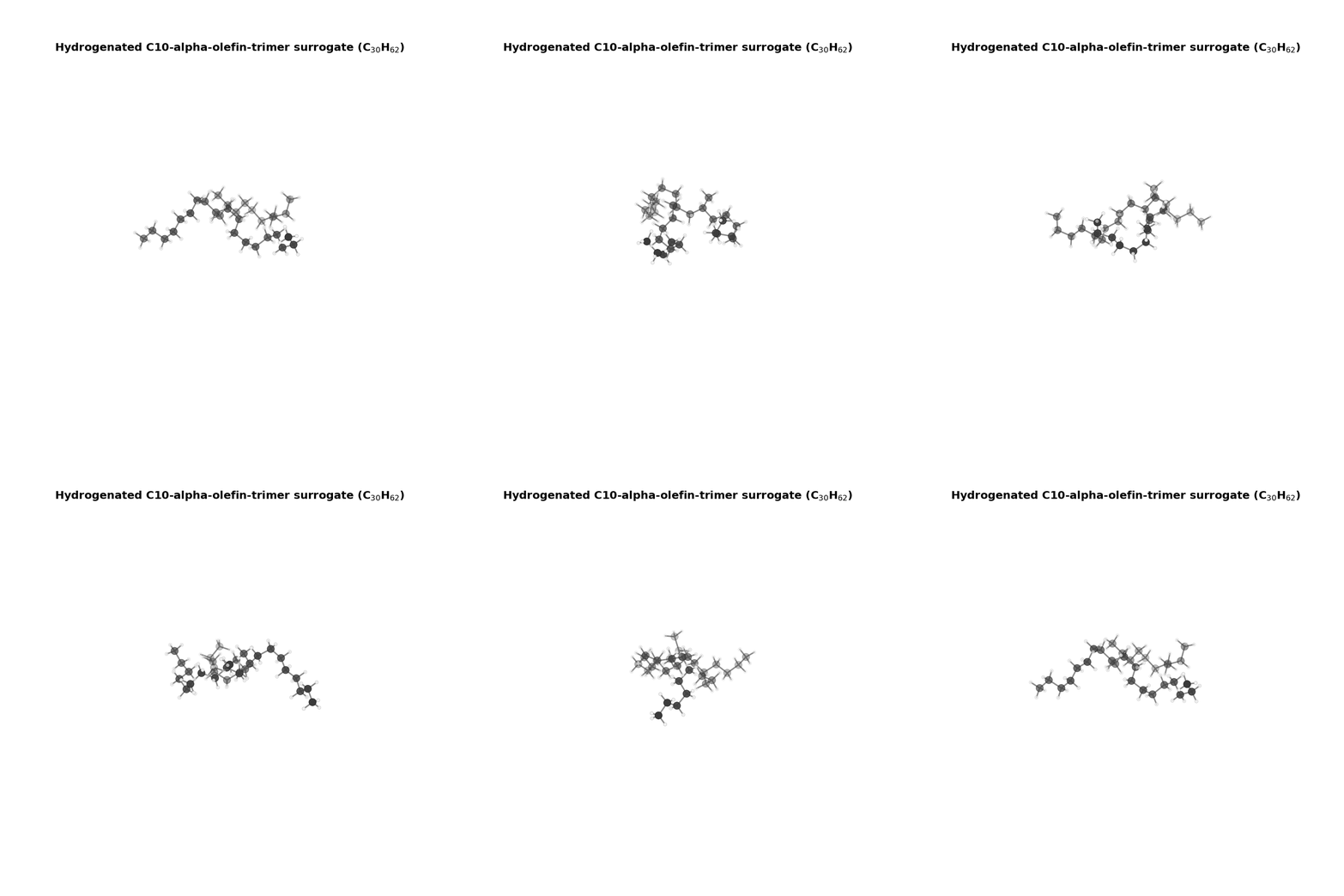
Hydrogenated C10-alpha-olefin-trimer surrogate (C30H62). This molecules is our key candidate for achieving quantum advantage for simulation of NMR spectra.
When the peaks in time aren’t enough
That is where nuclear magnetic resonance (NMR) can add another kind of information. Chromatography separates components; NMR can reveal structural features of the molecules, such as patterns of branching. Researchers have used NMR to study commercial and laboratory-made PAOs, including to identify different branched structures in products derived from 1-decene [6].
But what if an analysis could begin and end with NMR? A sample could be measured as a whole, and its spectrum interpreted to determine the composition. The appeal is clear: the workflow might avoid a chromatographic separation. But whether NMR can provide the specific compositional answers needed and how long the measurement and interpretation would take depends on the sample and the analytical method. The challenge is turning the spectrum into a reliable, validated account of what is in the mixture.
The obstacle is that the spectrum of a whole mixture is a superposition of every molecule inside. And for molecules this closely related those signals overlap into a dense weave of blended lines.
Analyzing the spectrum is an inversion problem. You want to know: given this spectrum, which combination of molecules produced it? To answer, you need the other direction first — for every plausible candidate molecule, predict what its spectrum would look like. Then search for the mixture whose combined predicted spectrum best matches the measurement, and report the result with honest uncertainty bars.
Chromatography spends laboratory time separating molecules. A simulation-led approach would spend computation trying to distinguish them inside the measurement. The question is whether that computation can become accurate enough, and affordable enough, to make separation optional for a given analytical task.
So what about quantum computing?
To predict an NMR spectrum, we do not need to calculate every electron in every molecule from scratch. Once we have estimates of the relevant chemical shifts and interactions between nuclear spins, we can build an effective spin model: a description of how those nuclei behave in an NMR experiment. The task is then to let the model evolve and calculate the signal it would produce.
A quantum computer can represent those spins with qubits, simulate their evolution, and use the resulting time-dependent signal to construct a predicted spectrum. Researchers have already demonstrated this basic approach on quantum hardware, including for a molecular spin model larger than those in the earliest demonstrations. Those experiments show that the approach is possible [7].
Therefore the potential computing bottleneck is not simply that PAO molecules have long carbon chains. It is that interacting nuclear spins can produce collective behavior that becomes difficult to simulate accurately. An exact calculation must keep track of a space of possible spin states that grows exponentially with the number of spins included. For some molecules and experimental conditions, classical methods avoid that full calculation very effectively by focusing on smaller clusters or restricting which spin correlations they track. For others, those shortcuts may lose spectral details we care about. The wall is therefore not a fixed molecular size; it is the point where the classical shortcuts stop giving a sufficiently accurate answer at an acceptable cost [8].
The comparison has to be specific. Could quantum hardware calculate the spectral features needed for this analytical question, to this accuracy, using fewer resources than an optimized classical approach? Our classical work, including ways to limit calculations to the spin behavior most relevant to the signal, raises the bar for any quantum advantage.
Is the information even there?
Lets consider the fact that we would want to analyze complex spectra a little more. This matters for the proposed PAO analysis because the spectrum of the whole oil is not the spectrum of a single molecule. Many related molecules contribute overlapping signals. To work backward from that measurement to composition, we would need to predict and compare signals from plausible components. And do this potentially many times as we test different candidate mixtures. Faster spectrum calculation could make that search more practical. But it would not, by itself, guarantee that the measured spectrum contains enough information to distinguish every candidate.
Where quantum simulation really enters
This is where we enter territory that we have found much more difficult to simulate classically. The clustering approach for NMR simulation works extremely well for 1D NMR spectra. However, it is clear that, for complex mixtures, 1D NMR does not contain enough information. We have to use more complex pulse sequences.
The most direct candidate for a somewhat more information-rich spectrum is the so-called 2D COSY sequence, which consists of two pulses instead of one, as in 1D NMR. The second pulse comes after a time delay. So now we have the time we measure and the time delay. Fourier-transforming the result with respect to both gives us two frequencies. Hence, 2D NMR.
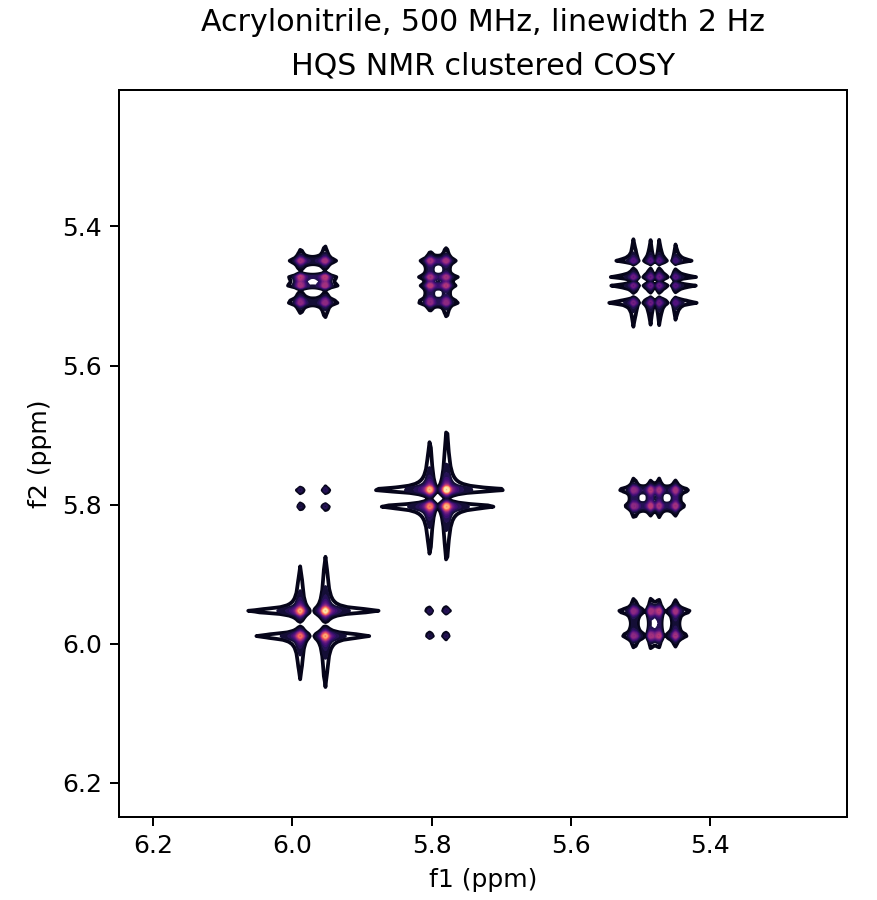
A 2D NMR spectrum for a simple molecule. The off-diagonals show coupled spins, and come about because of extra correlation created by the second pulse.
When considering classical approximation, the second pulse can be seen as a way to spread quantum correlation further through the molecule and gain additional information. In turn this is great and gives you more information .... but makes simulation harder. Of course, we are not limited to 2D methods: 3D, 4D and beyond exist and sequences like TOCSY fundamentally do the same thing — spread correlation. But we found that for long hydrocarbon chains, even 2D COSY, a thoroughly established technique, can be very difficult to simulate classically.
Towards useful quantum advantage
The term “quantum advantage” is often applied too quite loosely: any problem where a quantum machine outperforms a classical one, however artificial. The 2D COSY case is different. If a quantum computer calculates the 2D COSY spectrum of a branched hydrocarbon efficiently, so for the class of molecules that actually occur in PAO lubricants, and does this at the size where our best classical methods, including the clustering that makes 1D simulation tractable, struggle to capture the full correlation structure — that is not a contrived benchmark.
It is the calculation the proposed workflow for mixture analysis needs, performed on chemically relevant molecules, in exactly the regime where the classical shortcuts stop working. Demonstrating that would be useful quantum advantage in the strict sense: quantum hardware doing the a piece of computation where the result is actually relevant.
This is why the upcoming experiment matters. In the coming months, HQS Quantum Simulations will test whether a quantum computer performs exactly these simulations efficiently. If it does, it removes the known limit of the software route for NMR based mixture analysis: the size and complexity of the molecules that can be simulated .
The long path to a day-to-day workflow
Even so, a quantum advantage in spectrum simulation is a milestone, but not he finished workflow. Between “we can calculate a hard 2D COSY spectrum on quantum hardware” and “a lab certifies a batch of oil without touching a chromatograph” lie many layers.
A quantum advantage in simulating a 2D COSY spectrum would be an important computational result—but it would not, by itself, amount to a new method for analyzing PAO mixtures. Turning that calculation into a workflow would require reliable effective spin models for the molecules likely to be present, including their chemical shifts and J-couplings. It would also require a way to compare predicted spectra with the spectrum of a real mixture, estimate its composition and quantify uncertainty. Some mixtures may remain difficult to distinguish, even with better simulations; a robust method would need to recognize and report that limitation.
The results would then have to be tested against mixtures of known composition and compared with established GC and NMR analyses of real samples. They would need to be reproducible and trustworthy across laboratories. And the measurement itself would have to work on suitable NMR hardware, potentially in a compact instrument near the sample. These are significant steps from demonstrating quantum advantage on a calculation to replacing chromatography for a particular analytical task.
Nonetheless, simulating the 2D COSY spectra of relevant branched hydrocarbons beyond the reach of the best practical classical methods would be a watershed moment for quantum computing. We hope to achieve it soon.