

Benchtop NMR feasibility
Can benchtop NMR see enough signal for your application?
Preview how field strength, concentration, scan time, linewidth, and noise will affect a spectrum before committing samples, operator time, or instrument budget.
The practical question is spectral visibility
Benchtop NMR can bring spectroscopy closer to routine chemistry, process monitoring, quality control, and teaching laboratories. For many applications, however, the deciding factor is signal-to-noise ratio: will the spectrum be clear enough, quickly enough, on the instrument available?
The spectrum a user inspects depends on concentration, sample volume, field strength, probe sensitivity, receiver bandwidth, scan count, linewidth, relaxation behavior, temperature, and processing choices such as filtering, apodization, baseline correction, and peak fitting.
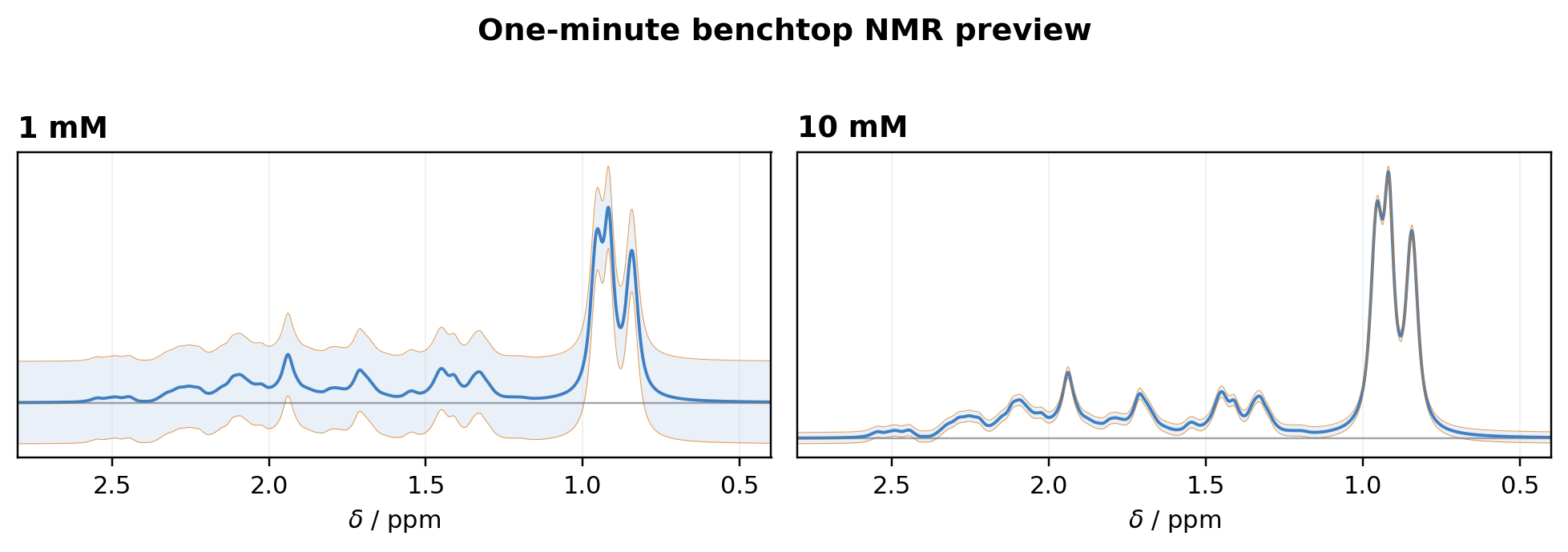
Why simulation helps
A marginal benchtop NMR experiment may become useful with more scans, higher concentration, a different processing method, or a different experimental setup. Without a preview of the expected spectrum, it is difficult to know where that transition might lie.
HQS develops simulation-guided workflows that help make low-field spectral structure and experimental trade-offs visible before the full experiment is run.
What HQS can support
- Predict spectra at low-field and benchtop frequencies.
- Model full multiplet structure, including strongly coupled systems.
- Explore how acquisition assumptions affect spectrum visibility.
- Frame a realistic experiment plan without removing hardware limits.
Careful by design
A simulation preview is a planning tool: a way to decide which experimental regime is worth testing, which assumptions are limiting, and whether benchtop NMR is a credible path for the application under discussion.
Have a benchtop NMR feasibility question?
HQS can discuss how spectrum prediction and low-field NMR simulation could support your workflow assessment.
Talk to HQS