

Low-Field NMR Interpretation
Affordable low-field NMR needs reliable spectral prediction
Benchtop and other low-field 1H NMR systems can make blood-metabolite measurement more accessible, compact, and practical. But reliable interpretation remains difficult when disease-relevant information is hidden inside overlapping mixture spectra.
Why this matters
Blood contains many NMR-visible metabolites, including glucose, lactate, alanine, glutamate, aspartate, and valine. These molecules are connected to energy metabolism, amino-acid metabolism, and broader changes in physiology. Low-field measurement makes this type of analysis more accessible, but accessibility alone does not make the spectra easy to interpret.
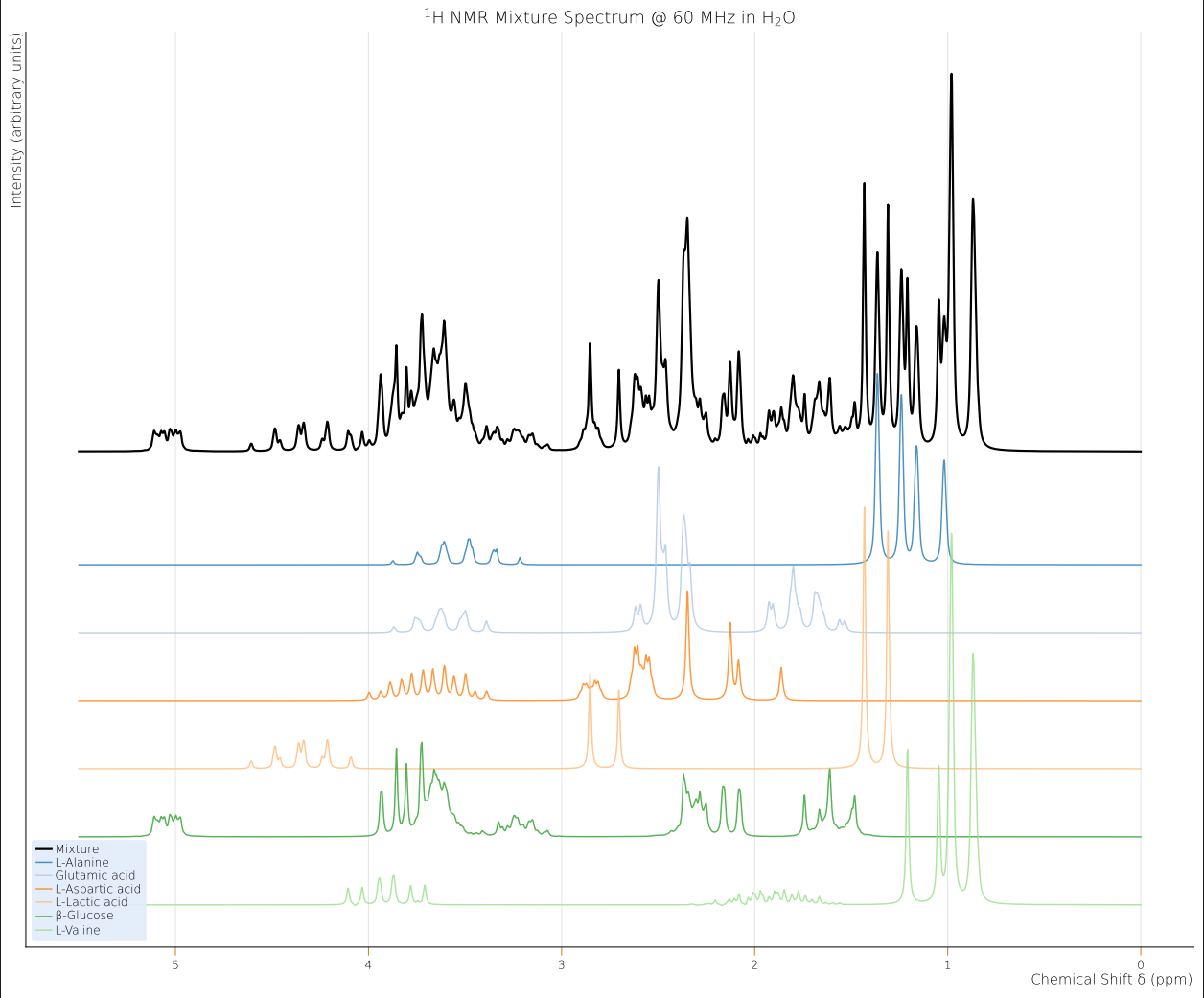
Where interpretation breaks down
At low magnetic field, resonances are compressed in frequency. At 60 MHz, a shift difference of 0.1 ppm is only about 6 Hz. Signals that may be easier to separate at high field become strongly congested, and the mixture can no longer be interpreted peak by peak with confidence.
In blood-metabolite mixtures, this problem appears repeatedly across the spectrum:
- 4.0 to 3.0 ppm: glucose and amino-acid signals overlap
- 2.8 to 2.0 ppm: glutamate and aspartate features become congested
- 1.5 to 0.8 ppm: methyl signals from lactate, alanine, valine, and others are not uniquely specific
Pulse sequences help, but they are not the whole answer
Water suppression, selective excitation, J-resolved methods, 2D experiments, pure-shift-style approaches, and other targeted selective experiments can reduce complexity or focus on narrower parts of a mixture. These methods matter. But they still depend on knowing which signals are worth targeting, whether those signals remain selective at low field, and how the resulting spectrum should be interpreted under the actual measurement conditions.
Prediction is the missing layer between measurement and interpretation
Accurate prediction is what connects low-field measurement to reliable interpretation. It helps determine which signals are likely to remain distinguishable, which selective or simplifying experiment is worth running, and how the resulting spectrum should be read under the actual measurement conditions.
This matters because low-field spectra do not behave like compressed high-field references. Overlap, strong-coupling effects, linewidth, and sample conditions can all change which features are useful and how specific they really are. Public metabolite databases remain highly valuable, but high-field spectra cannot simply be scaled down and treated as reliable low-field references.
In that sense, prediction is not just a library of expected peaks. It is the practical layer that helps make both standard and targeted low-field NMR experiments interpretable.
HQS perspective
Low-field NMR becomes more useful when experiment choice and spectrum interpretation are supported by physics-based prediction rather than by visual inspection alone. HQS focuses on predictive NMR modeling that can help teams judge which spectral features are likely to be informative, which low-field measurements are worth prioritizing, and how the resulting signal can be interpreted in a traceable way.
The role of prediction is not to override the underlying resolution limits of low-field hardware, but to make better use of the signal that benchtop instruments can already measure by connecting it more reliably to molecular interpretation.
Takeaway
Low-field NMR can make blood-metabolite analysis faster, cheaper, and more accessible. But useful interpretation still depends on predicting the parts inside the mixture. Accurate low-field component-spectrum prediction is a practical step toward more reliable metabolite identification and quantification workflows.